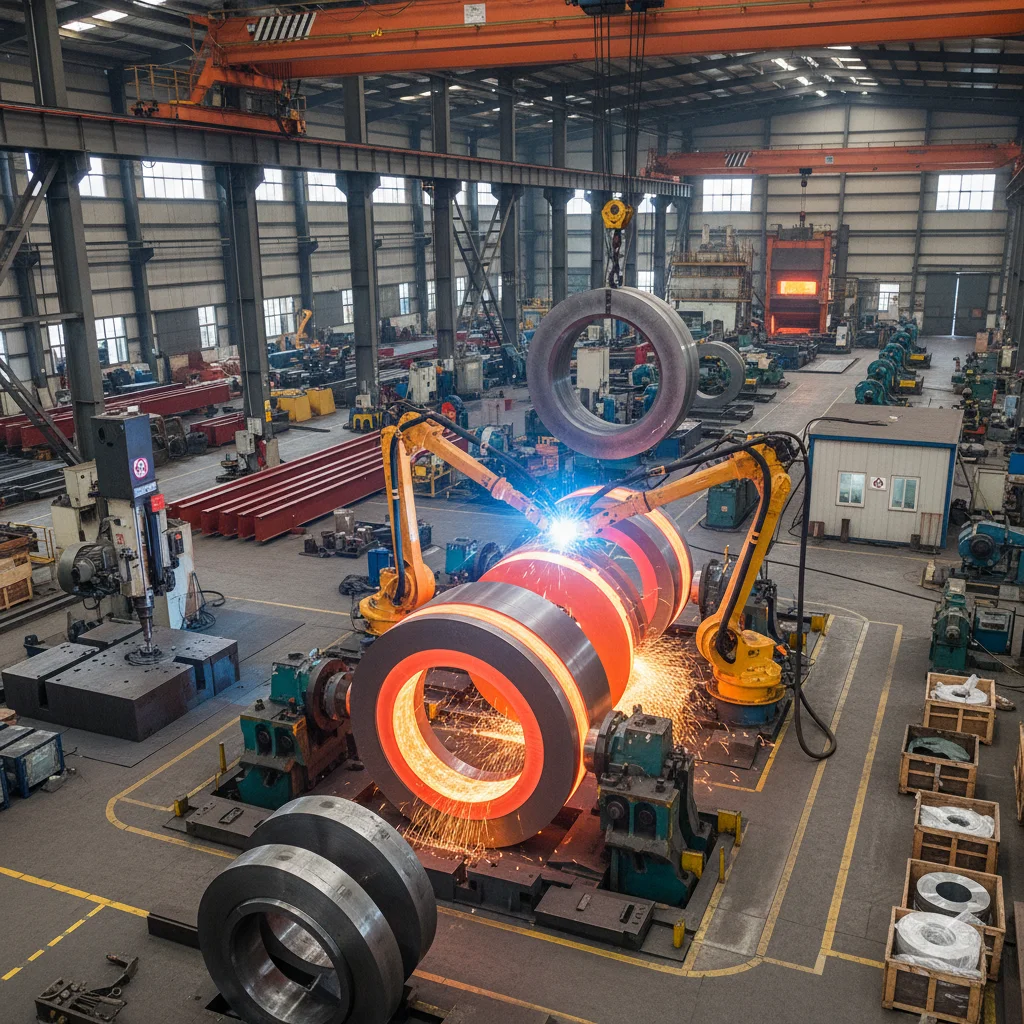
In the complex world of industrial pressure piping, the role of a high-quality seamless rolled ring forging factory is pivotal for ensuring structural integrity and safety. Forging processes, particularly those producing critical components like blind flanges, are essential for sealing line ends and vessel nozzles where failure is not an option. Understanding the intersection of material science and precision machining allows engineers to select the right forged parts for high-pressure environments.
The global demand for precision forged components has grown as industries shift toward more extreme operating conditions, requiring materials that can withstand higher temperatures and corrosive agents. Whether it is for oil and gas, chemical processing, or power generation, the ability of a specialized manufacturer to maintain dimensional compliance and traceability is a key differentiator. This commitment to quality ensures that every component meets stringent international standards.
Choosing a reliable seamless rolled ring forging factory allows procurement teams to secure ASME B16.5 compliant blind flanges that offer unmatched reliability. By focusing on forged base materials rather than cast alternatives, companies can significantly improve material consistency and pressure-service confidence across their entire piping infrastructure.

The Industrial Significance of Forged Blind Flanges
Forged blind flanges serve as the critical terminal points in pressure piping systems, providing a secure seal for line ends, vessel nozzles, and future expansion points. Unlike standard flanges, these components must bear the full force of the system's internal pressure without any exit flow, making the structural integrity of the forged base material paramount.
By utilizing a professional seamless rolled ring forging factory, manufacturers can ensure that the grain flow of the metal is optimized, which significantly reduces the risk of internal voids or weaknesses. This mechanical advantage is what makes forged flanges superior to cast versions for high-risk industrial applications.
Material Standards for High-Pressure Forgings
The selection of materials is the first line of defense in any pressure system. For ASME B16.5 blind flanges, the use of carbon steels like A105 or low-temperature alloys such as A350 LF2 is standard. These materials provide the necessary strength and ductility to handle fluctuations in pressure and temperature without brittle failure.
For more aggressive environments, stainless steel and alloy grades like A182 F304, F316, F51, F11, and F22 are employed. These grades are essential for resisting corrosion in chemical plants or high-heat stability in power generation facilities, ensuring that the sealing surface remains intact over decades of service.
A specialized seamless rolled ring forging factory ensures that these materials are not only sourced correctly but are also heat-treated according to the project scope. Proper normalization and tempering are critical to achieving the desired mechanical properties, such as hardness and yield strength, as specified by international standards.
Precision Machining and Dimensional Compliance
While the raw forging provides the strength, the final utility of a blind flange depends on its machining accuracy. A seamless rolled ring forging factory must focus on the precision of the facing, bore, and drilling patterns to ensure a leak-proof seal when mated with gaskets and piping.
Dimensional compliance is where the theoretical design meets real-world application. Every aspect, from the serration of the facing to the precise tapping of bolt holes, must adhere to the ASME B16.5 standard. Any deviation in the drilling pattern can lead to installation failures or compromised joint integrity in the field.
Furthermore, providing additional machining stock allows customers to perform final adjustments on-site if required. This flexibility, combined with the rigorous standards of a seamless rolled ring forging factory, ensures that the components integrate perfectly into complex project-specific piping layouts.
Quality Inspection and NDT Protocols
To guarantee the safety of pressure systems, a rigorous inspection regime is non-negotiable. This includes Non-Destructive Testing (NDT) such as Ultrasonic Testing (UT), Magnetic Particle Testing (MT), and Penetrant Testing (PT) to detect internal flaws or surface cracks that could lead to catastrophic failure under pressure.
Beyond NDT, Positive Material Identification (PMI) and hardness checks are conducted to verify that the chemical composition and mechanical properties of the steel match the requested grade. This level of scrutiny ensures that a seamless rolled ring forging factory delivers a product that is not only visually correct but metallurgically sound.
Performance Rating of Forging Quality Control Methods
Strategic Applications in Piping Systems
The application of forged blind flanges extends far beyond simple end-capping. In large-scale industrial plants, they are strategically used as nozzle closures for pressure vessels and as blanking services for pressure systems during maintenance or testing phases. This allows for a controlled environment where sections of a plant can be isolated without shutting down the entire operation.
Additionally, they serve as essential "future expansion points." By installing a blind flange during the initial build, companies can easily add new piping branches or upgrade their systems in the future without needing to cut into existing lines or perform risky on-site welding. This foresight reduces long-term operational costs and downtime.
The Value of Comprehensive Project Documentation
In regulated industries, the physical product is only half of the delivery; the documentation is the other half. A certified seamless rolled ring forging factory provides EN 10204 3.1 certificates, which trace the material back to the original heat number, ensuring total transparency of the supply chain.
Detailed dossiers containing heat-treatment records, NDT reports, and dimensional inspection sheets are mandatory for project-based orders. These documents provide the necessary evidence for safety auditors and insurance companies that the components installed in a high-pressure system meet all engineering specifications.
Furthermore, the option for third-party witness inspections adds an extra layer of security. When a recognized independent agency verifies the testing process at the factory, the end-user gains absolute confidence in the product's reliability and compliance with global safety standards.
Future Trends in Forging Technology
The forging industry is currently undergoing a digital transformation. The integration of AI-driven process control in a seamless rolled ring forging factory allows for more precise temperature management during the rolling process, resulting in even more consistent grain structures and reduced material waste.
Sustainability is also becoming a core focus. New energy-efficient heating methods and a shift toward recycled high-grade alloys are reducing the carbon footprint of forged components. This transition helps industrial clients meet their ESG goals without sacrificing the mechanical performance of their pressure piping.
Moreover, the adoption of advanced simulation software allows engineers to predict how a forged part will behave under extreme stress before it is even produced. This "digital twin" approach minimizes errors and accelerates the development of custom forgings for specialized aerospace or deep-sea applications.
Comparative Analysis of Forging Supply Conditions
| Supply State |
Machining Level |
Typical Use Case |
Lead Time Impact |
| Forging Blank |
Minimal/Rough |
In-house final machining |
Shortest |
| Heat-Treated |
Rough Machined |
Standard project stock |
Moderate |
| Semi-Finished |
Partial Facing |
Specific custom fits |
Moderate |
| Fully Machined |
Precision Finish |
Immediate installation |
Longest |
| Custom-Drilled |
Project-Specific |
Non-standard patterns |
Moderate |
| NDT Certified |
Final Finished |
Critical pressure zones |
Moderate |
FAQS
Forged blind flanges are created through mechanical deformation, which aligns the grain flow of the metal and eliminates internal porosity. This makes them significantly stronger and more reliable under high pressure than cast flanges, which can have internal air pockets or inconsistent density. A professional seamless rolled ring forging factory always recommends forged options for critical pressure piping projects to ensure maximum safety.
For low-temperature applications, A350 LF2 is the industry standard for carbon steel. It is specifically designed to maintain its toughness and avoid brittle fracture at sub-zero temperatures. Depending on the exact temperature requirements, a seamless rolled ring forging factory can provide these in various heat-treated conditions to ensure the material meets the required Charpy V-notch impact tests.
An EN 10204 3.1 certificate is a validation document issued by the manufacturer's authorized inspection representative. It confirms that the products supplied are in compliance with the order specifications and provides the actual chemical analysis and mechanical test results from the specific heat of steel used. This ensures full traceability from the raw ingot to the finished flange.
Yes, while ASME B16.5 provides standard drilling patterns, most specialized factories can accommodate project-specific dimensions. Whether you need unique bolt hole alignments or specific tapping for custom fasteners, a seamless rolled ring forging factory can machine the flange according to your technical drawings, provided the dimensional changes do not compromise the pressure rating of the part.
Machining stock refers to additional material left on the outer diameter (OD), inner diameter (ID), or facing of the forging. This is critical for project-based orders where the end-user may need to perform a final precision grind or face the flange on-site to ensure a perfect fit against a specific mating surface, accounting for any minor site-specific misalignments.
The choice depends on what you are looking for. Ultrasonic Testing (UT) is best for finding deep internal flaws. Penetrant Testing (PT) and Magnetic Particle Testing (MT) are superior for detecting surface-level cracks. For critical high-pressure components, a seamless rolled ring forging factory often suggests a combination of UT for the volume and PT for the surface to ensure 100% integrity.
Conclusion
The procurement of ASME B16.5 blind flanges is a decision that balances material science, precision engineering, and strict regulatory compliance. By partnering with a competent seamless rolled ring forging factory, industries can ensure that their pressure systems are sealed with components that offer superior material consistency, verified traceability, and precise dimensional accuracy. From the initial selection of A105 or stainless steel grades to the final NDT certification and EN 10204 3.1 documentation, every step in the forging process is designed to mitigate risk and enhance operational safety.
Looking forward, the integration of digital twins and sustainable forging practices will further refine the reliability of these critical components. For engineers and procurement managers, the priority should remain on quality over cost, as the long-term value of a perfectly forged flange is measured in the prevention of costly downtime and the assurance of human safety. To secure the highest standard of forged components for your next project, visit our website: www.yxs-forging.com.