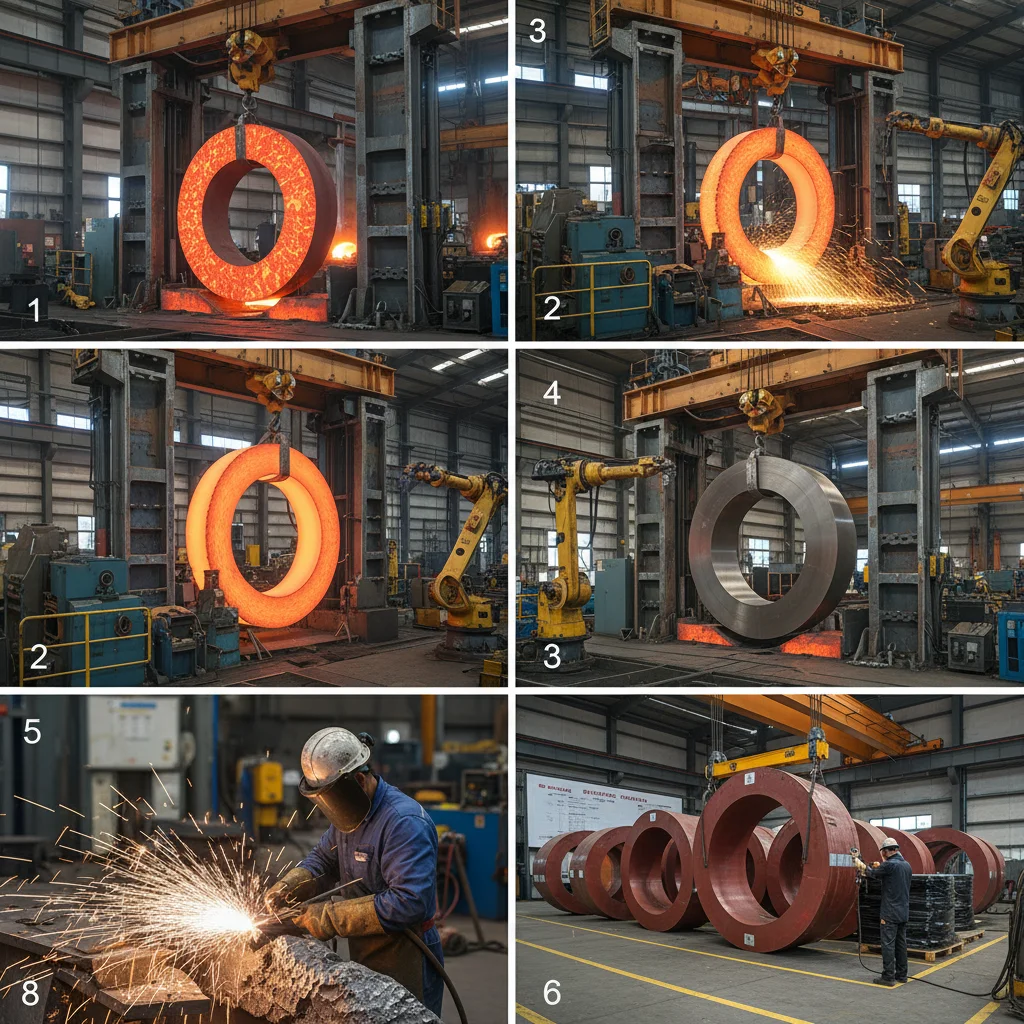
The global demand for high-pressure structural components has led to a significant evolution in how industrial enterprises source their heavy-duty cylindrical parts. For sectors relying on extreme load-bearing capacity, finding a reliable rolled ring manufacturer factory is no longer just about procurement, but about ensuring the fundamental safety and longevity of critical hydraulic systems.
In the context of modern forging, the transition from fabricated or cast barrels to precision-engineered forged blanks represents a shift toward zero-defect manufacturing. This approach addresses the critical challenges of wall-thickness consistency and internal structural integrity, which are often the primary failure points in high-pressure industrial applications.
By partnering with a specialized rolled ring manufacturer factory, engineers can secure components that offer superior grain flow and higher pressure reliability, ensuring that heavy hydraulic equipment operates at peak efficiency under the most rigorous industrial stress.

The Strategic Importance of Forged Cylinder Barrels
Large Hydraulic Cylinder Barrel Forgings are the backbone of heavy-duty press systems and industrial machinery. Unlike fabricated alternatives, these forged blanks provide a continuous grain structure that is essential for resisting extreme loads through the wall section, bore, and end faces, effectively eliminating the risk of voids or weld-line failures.
The strategic value of utilizing a professional rolled ring manufacturer factory lies in the ability to achieve exceptional wall-thickness consistency. This precision is critical for subsequent honing and sealing-area machining, ensuring that the final hydraulic system maintains a perfect seal under thousands of pounds of pressure per square inch.
Defining the Standards of a Rolled Ring Manufacturer Factory
A true rolled ring manufacturer factory is defined by its ability to merge metallurgical science with precision mechanical engineering. It is not merely a production site but a facility capable of managing the entire lifecycle of a forging, from raw ingot selection—using grades like 42CrMo4, 20Mn5, or 4140—to final heat treatment and precision machining.
Modern standards require that such a factory implements rigorous Non-Destructive Testing (NDT) protocols. This includes Ultrasonic Testing (UT) to detect internal flaws and Magnetic Particle (MT) or Penetrant Testing (PT) for surface integrity, ensuring that every barrel delivered meets international audit requirements such as EN 10204 3.1.
Furthermore, the capacity to provide customized geometries, such as stepped shoulders and specific counterbores, distinguishes a high-tier factory from a general forge. This flexibility allows engineers to reduce the amount of material removal during the final machining phase, thereby preserving the integrity of the forged grain flow.
Core Technical Components for High-Pressure Reliability
The reliability of a high-pressure cylinder begins with material traceability. A professional rolled ring manufacturer factory ensures full heat number tracking from the raw ingot to the finished product, which is paramount for industries where a single component failure could lead to catastrophic system collapse.
Another core component is the optimization of the forging process to ensure bore straightness. By utilizing advanced hydraulic press control, a rolled ring manufacturer factory can minimize distortion, providing an ideal foundation for the critical boring and honing operations that define the cylinder's final performance.
Finally, heat-treatment compatibility is essential. The selection of alloys and the precision of the quenching and tempering process allow the component to reach the optimal balance of hardness and toughness, a standard strictly maintained by any leading rolled ring manufacturer factory to prevent stress cracking under load.
Global Applications of Precision Forged Rings
Precision forged barrels and rings are deployed across a spectrum of critical global industries. In the heavy manufacturing sector, they are used in massive press systems for automotive stamping, while in the energy sector, they form the core of high-pressure hydraulic actuators used in offshore drilling and pipeline management.
From the industrial zones of East Asia to the heavy machinery hubs in Europe and North America, the adoption of components from a specialized rolled ring manufacturer factory has reduced equipment downtime. By replacing cast barrels with forged ones, companies have reported a significant extension in the duty cycle of their hydraulic systems.
Performance Analysis of Forging Methods
Long-Term Value and Safety Advantages
The primary long-term value of investing in forged barrels is the drastic reduction in risk. Because a rolled ring manufacturer factory produces parts with continuous grain flow, the risk of internal leaks or structural bursts is minimized, which translates directly into higher safety ratings for the overall industrial installation.
Beyond safety, there is a clear economic advantage. While the initial cost of a forging may be higher than a casting, the extended service lifespan and reduced need for frequent replacements result in a lower total cost of ownership. This reliability fosters a culture of trust between the equipment operator and the engineering specifications.
Future Innovations in Forging Technology
The industry is currently moving toward "Smart Forging," where digital twins and real-time thermal monitoring are used to predict the internal grain structure of a part before it even leaves the press. A forward-thinking rolled ring manufacturer factory is integrating these technologies to ensure a perfect match between the forged blank and the final machining requirements.
Sustainable metallurgy is also becoming a priority. The development of new alloy grades that require lower forging temperatures while maintaining high strength is helping factories reduce their carbon footprint. This shift toward green energy in the manufacturing process does not compromise the structural integrity of the hydraulic barrels.
Additionally, the integration of AI-driven quality control is automating the NDT process. Future systems will allow for 100% volumetric inspection of every barrel with higher accuracy than traditional UT, ensuring that every component delivered by a rolled ring manufacturer factory is absolutely defect-free.
Overcoming Challenges in Custom Ring Forgings
One of the most persistent challenges in the industry is managing the distortion that occurs during the cooling of large-diameter forgings. To solve this, a professional rolled ring manufacturer factory utilizes controlled cooling rates and precise machining allowances, ensuring that the final bore meets strict concentricity tolerances.
Another challenge is the balance between hardness and toughness. Over-hardening can lead to brittleness, while under-hardening results in premature wear. The solution lies in optimized heat-treatment response profiles, tailored specifically to the hydraulic grade of the steel being used.
Finally, the complexity of custom geometries often leads to increased lead times. By optimizing the transition from forging to rough machining, a rolled ring manufacturer factory can significantly compress the production schedule without sacrificing the quality of the final product.
Comparative Analysis of Barrel Production Methods
| Production Method |
Structural Integrity |
Pressure Resistance |
Service Lifespan |
| Precision Forged (Factory A) |
Continuous Grain Flow |
Extreme High |
Extended Duty |
| Custom Forged (Factory B) |
High Continuity |
Very High |
Long Term |
| Traditional Casting |
Prone to Voids |
Moderate |
Standard |
| Welded Fabrication |
Weld-line Weakness |
Risk of Leaks |
Short to Medium |
| Rough Machined Cast |
Inconsistent Grain |
Moderate |
Standard |
| Seamless Forged Ring |
Superior Flow |
Extreme High |
Maximized |
FAQS
Depending on the specific application, we typically utilize high-strength alloy steels such as 42CrMo4, 20Mn5, or 4140. These materials are selected because they offer the ideal balance of toughness, hardness, and a predictable response to heat treatment, which is critical for maintaining structural integrity in high-pressure hydraulic services.
Forged barrels are significantly superior due to the refinement of the grain structure during the forging process. This results in higher fatigue strength and better pressure resistance. Unlike casting, which can have voids, or welding, which creates potential leak points, forging ensures a continuous, dense material structure.
We adhere to strict international standards, providing full Ultrasonic Testing (UT), Magnetic Particle (MT), and Penetrant Testing (PT). Every shipment is accompanied by EN 10204 3.1 certification, detailed heat-treatment records, and dimensional reports to ensure complete compliance with project specifications.
Yes, we offer flexible supply conditions. Parts can be delivered as-forged, heat-treated, or rough-machined (covering OD, ID, and faces). This allows our clients to reduce the workload on their internal machining facilities while still benefiting from the precision of a specialized rolled ring manufacturer factory.
We utilize controlled forging temperatures and precise hydraulic press movements to minimize distortion. By providing strategically calculated stock for boring and facing, we ensure that the final machined bore meets the strictest straightness and concentricity tolerances required by the engineering drawings.
Absolutely. We specialize in custom hollow forgings. We can incorporate specific shoulders, counterbores, and transition pieces directly into the forging stage or the rough-machining stage, ensuring that the grain flow remains continuous across these geometric changes according to your technical drawings.
Conclusion
The selection of a high-performance hydraulic cylinder barrel is a decision that impacts the safety and efficiency of an entire industrial system. By prioritizing the superior mechanical properties and grain continuity provided by a professional rolled ring manufacturer factory, companies can transition from standard industrial-grade equipment to critical-application grade machinery that resists leaks, withstands extreme pressure, and extends the overall service lifespan of their assets.
Looking ahead, the integration of smart forging and sustainable metallurgy will only further enhance the reliability of these components. For engineers and procurement specialists, the goal should be to establish partnerships based on material traceability, rigorous NDT standards, and precision engineering. For high-performance hydraulic solutions, we invite you to visit our website: www.yxs-forging.com.