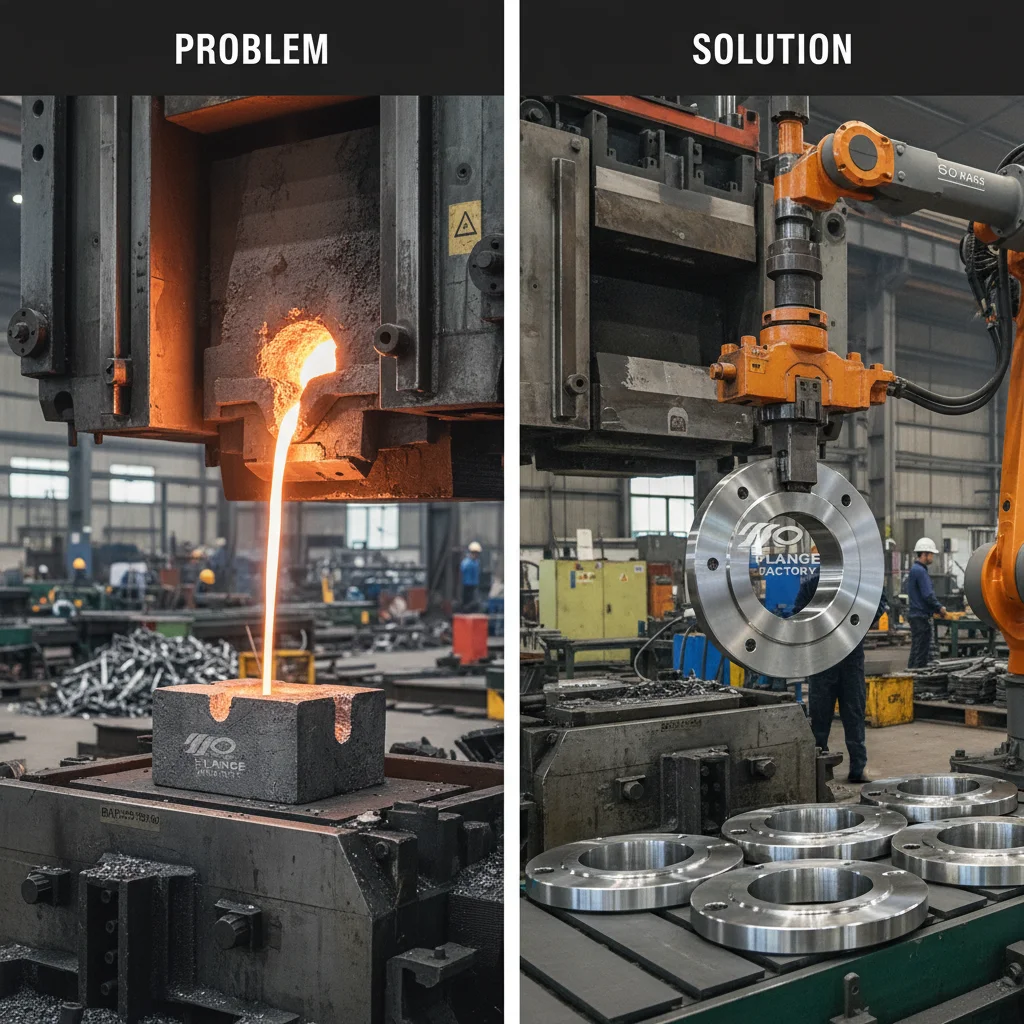
In the demanding landscape of heavy industrial manufacturing, the precision and structural integrity of components are paramount to operational safety. A professional forged hollow cylinder factory provides the critical engineering bridge between conceptual technical drawings and high-performance physical assets, ensuring that non-standard geometries meet the most rigorous stress requirements. By leveraging controlled forging processes, these facilities eliminate the inherent weaknesses of casting, offering components with superior grain flow and fatigue resistance.
The global shift toward specialized infrastructure, including advanced energy plants and heavy-duty rotating machinery, has increased the reliance on custom-engineered forgings. When standard catalog dimensions fail to meet the exact technical specifications of an OEM or EPC project, the expertise of a specialized factory becomes indispensable. These entities don't just produce metal parts; they deliver engineered solutions that guarantee a perfect fit and absolute structural reliability in high-stakes environments.
For procurement managers and lead engineers, partnering with a reliable forged hollow cylinder factory ensures that materials such as alloy steel, stainless steel, and duplex steel are processed according to strict international standards. This collaboration reduces downstream machining costs and mitigates the risk of catastrophic failure in critical industrial assemblies.

The Role of a Forged Hollow Cylinder Factory in Modern Industry
A dedicated forged hollow cylinder factory serves as a cornerstone for heavy-industry projects where structural integrity is non-negotiable. Unlike mass-production facilities, these factories specialize in drawing-based production, allowing for the creation of rings and cylinders with outer diameters up to 8000mm and weights reaching 30 tons. This capability is essential for creating the skeletal structures of large-scale industrial machinery.
By optimizing the grain flow of the metal during the forging process, these factories provide components that offer significantly higher strength and fatigue resistance than cast alternatives. This technical advantage is critical for parts subjected to extreme pressure or constant rotation, ensuring that the final product can withstand the rigors of intense industrial operation without premature failure.
Engineering Precision via Drawing-Based Manufacturing
The core philosophy of a high-end forging facility is the transition from catalog-based ordering to drawing-based engineering. By centering production entirely around customer-provided technical drawings, the factory can achieve a precision fit for specialized industrial assemblies. This eliminates the need for excessive "over-machining" and ensures that the final component aligns perfectly with the surrounding system architecture.
Precision in drawing analysis allows the factory to optimize forging ratios, which in turn maximizes material usage and reduces waste. This process involves a detailed review of the non-standard geometry to ensure that the metal is moved efficiently during the forging strike, preventing internal voids or structural anomalies that could compromise the part's integrity.
Furthermore, this tailored approach allows for the integration of complex profiles and wall sections that are impossible to find in standard inventories. Whether it is a specialized flange ring or a heavy-wall cylinder, the ability to follow a custom blueprint ensures that the resulting part meets the exact mechanical properties and dimensional tolerances required by the project's lead engineers.
Material Versatility and Structural Reliability
Selecting the right material is the first step in ensuring the longevity of a component produced by a forged hollow cylinder factory. Depending on the operating environment, factories utilize a broad spectrum of materials including carbon steel for general structural use, alloy steel for enhanced strength, and stainless or duplex steels for corrosive or high-pressure environments.
The structural reliability of these parts stems from the forging process itself, which refines the microstructure of the metal. When a forged hollow cylinder factory applies high pressure to the ingot, it closes internal pores and aligns the grain flow with the shape of the part, creating a dense, homogeneous structure that far exceeds the performance of machined-from-bar components.
This reliability is particularly evident in heavy rotating systems where centrifugal forces and thermal expansion can lead to fatigue. By combining superior material selection with optimized forging techniques, the factory ensures that every custom ring or cylinder possesses the necessary hardness and ductility to operate safely over an extended lifecycle.
Comparative Performance of Forging Methods
Understanding the value of drawing-based forging requires a comparison with traditional casting and machining methods. Casting often introduces porosity and inconsistent grain structures, which can lead to unpredictable failure points under heavy loads. In contrast, custom forging provides a refined grain flow that optimizes the mechanical properties of the steel.
When comparing life cycle costs, forged components typically offer a lower total cost of ownership due to extended service lives and reduced maintenance frequency. While the initial engineering phase for a custom drawing is more intensive, the result is a near-net shape forging that reduces material waste and downstream machining hours.
Forging Performance Comparison vs Other Methods
Integrated Machining and Thermal Control
A comprehensive manufacturing route is what separates a basic forge from a professional industrial partner. After the initial forging process, components undergo precision heat treatment to achieve target hardness and microstructure properties. This thermal control is critical for ensuring that the material does not become too brittle or too soft for its intended application.
Furthermore, integrated machining services—ranging from rough turning to finished profiles—significantly reduce the client's downstream costs. By delivering rings and cylinders that are already rough-machined to near-final dimensions, the factory ensures that the parts are ready for immediate installation or final precision grinding, streamlining the entire assembly line.
Global Applications for Custom Hollow Forgings
Custom forged components are essential across various high-stakes sectors globally. In the oil and gas industry, particularly for offshore EPC projects, forged hollow cylinders and rings are used in high-pressure valve bodies and flange assemblies where corrosion resistance and pressure containment are critical for environmental safety.
In the power generation sector, these components are found in heavy rotating systems and turbine housings. The ability of a forged hollow cylinder factory to produce parts up to 30 tons allows for the construction of massive generators and compressors that must operate with zero downtime for years at a time.
Additionally, in the aerospace and heavy marine sectors, the demand for specialized alloy and duplex steel forgings is constant. These industries require parts that can withstand extreme temperature fluctuations and saline environments, making the strict adherence to material certifications and precise forging ratios a necessity.
Quality Assurance and Traceability Standards
For global EPC projects, the physical part is only half of the delivery; the other half is the documentation. A professional factory implements a strict Inspection and Test Plan (ITP), which includes multi-stage dimensional checks and ultrasonic testing to ensure there are no internal defects. This rigorous approach guarantees that every part meets the specified technical requirements.
Traceability is managed through a comprehensive digital record system that tracks the product from the raw ingot to the final delivered piece. By providing EN 10204 3.1 or 3.2 certificates, the factory offers verifiable proof of the chemical and mechanical properties of the steel, ensuring compliance with international safety and quality standards.
The integration of real-time project tracking allows OEM partners to monitor production milestones, ensuring that delivery timelines are met and reducing the risk of assembly line delays. From specialized packaging for oversized rings to final shipping logistics, every step is documented to maintain a transparent and reliable supply chain.
Analysis of Custom Forging Quality and Performance Metrics
|
Performance Metric
|
Drawing-Based Forging
|
Standard Casting
|
Machined-from-Bar
|
| Structural Strength |
Superior (Refined Grain) |
Moderate (Porosity Risk) |
High (but inefficient) |
| Dimensional Fit |
Precision per Drawing |
Requires heavy machining |
Excellent |
| Material Waste |
Low (Near-net shape) |
Moderate |
Very High |
| Fatigue Resistance |
Maximum |
Low to Moderate |
High |
| Traceability |
Full EN 10204 3.1/3.2 |
Variable |
High |
| Service Life |
Extended |
Shorter |
Moderate |
FAQS
Standard rings follow generic size charts and common dimensions. Drawing-based rings are custom-engineered to your exact technical specifications, dimensions, and material requirements. This ensures they fit unique OEM or EPC project needs precisely, eliminating the need for extensive modification and ensuring the structural integrity is optimized for the specific load conditions of your project.
Yes, professional factories provide full traceability packages, including EN 10204 3.1 or 3.2 certificates. These documents verify the chemical composition and mechanical properties of the steel used, ensuring the material meets all project specifications and international safety standards required for high-pressure or corrosive environments.
Our production capabilities allow for custom rings and cylinders with an outer diameter (OD) of up to 8000mm and a height of up to 1200mm. We can handle maximum unit weights of up to 30 tons, making us capable of supporting some of the largest heavy-industry assemblies globally.
Absolutely. We offer a comprehensive manufacturing route. Depending on your requirements, we can supply components as-forged, heat-treated to specific hardness levels, rough machined, or fully finished. This integrated approach reduces your downstream costs and streamlines your assembly process.
For corrosive environments, we recommend stainless steels or duplex steels. These materials provide an exceptional balance of strength and corrosion resistance. Our expertise in handling high-alloy steels ensures that the forging process does not compromise the material's inherent protective properties.
Quality is managed through a strict Inspection and Test Plan (ITP). This includes full dimensional checks against the technical drawings, ultrasonic testing to detect internal flaws, and rigorous heat treatment management. Every stage is documented to ensure the final part is a perfect replica of the engineering drawing.
Conclusion
Selecting a professional forged hollow cylinder factory is a strategic decision that impacts the safety, longevity, and cost-efficiency of any heavy-industrial project. By combining drawing-based precision with advanced thermal control and a commitment to full traceability, these factories provide the structural reliability necessary for the world's most demanding OEM and EPC applications. The transition from standard components to custom-engineered forgings not only reduces material waste but also ensures that critical systems operate with maximum reliability.
As industry standards evolve toward greater sustainability and higher performance, the integration of near-net shape forging and rigorous ITP standards will become even more vital. We encourage engineers and procurement specialists to prioritize structural integrity and material traceability to mitigate risk in their assembly lines. For high-precision, custom-engineered forging solutions, visit our website: www.yxs-forging.com.