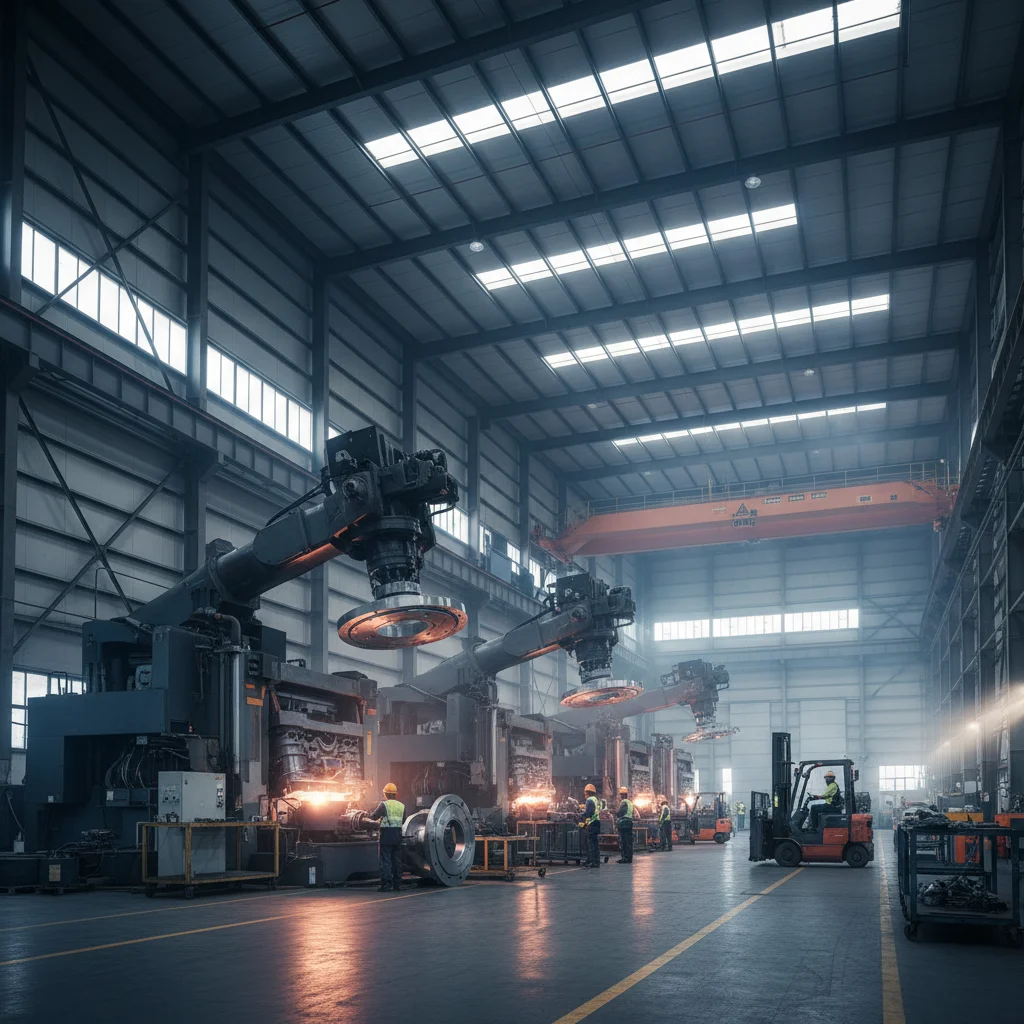
In the demanding world of high-pressure industrial equipment, the integrity of connection components is paramount. A professional forged rings factory provides the critical infrastructure needed to produce nozzle necks and forged rings that can withstand extreme stress, ensuring that pressure vessels and reactors operate safely under rigorous conditions.
The global shift toward more efficient energy production and chemical processing has increased the demand for components with superior material continuity. By leveraging advanced forging routes, a specialized forged rings factory ensures that the grain flow of the metal remains continuous, which significantly reduces the risk of structural failure compared to traditional fabricated pieces.
Understanding the nuances of forged nozzle necks—including weld preparation, bore allowance, and transition geometry—allows engineers to optimize vessel integration. For those seeking robust solutions for process equipment, partnering with a qualified forged rings factory is the most effective way to secure parts that balance machining stock with maximum structural strength.

The Role of a Forged Rings Factory in Pressure Equipment
A specialized forged rings factory does more than just shape metal; it engineers reliability. By utilizing hot forging processes, these factories create components like nozzle necks that are essential for transitions between thicker shells and connection sections, ensuring that the part can withstand higher pressures without compromising the integrity of the overall vessel.
The forging route chosen by the factory allows the part to maintain immense strength throughout a heavier section while preserving sufficient stock for precision machining. This balance is critical for customers who require robust connection components for reactors and heat exchangers where safety margins are non-negotiable.
Material Standards and Specifications in Forging
The selection of raw materials is a cornerstone of quality within a forged rings factory. Depending on the chemical environment and temperature requirements of the final application, materials such as SA-105 for carbon steel applications or SA-182 F11, F22, and F316 for alloy and stainless steel requirements are standard. These grades ensure that the component can resist corrosion and maintain mechanical properties under thermal stress.
Furthermore, the use of SA-350 LF2 is common for low-temperature services, where impact toughness is critical to prevent brittle fracture. The ability of a factory to source and certify these materials according to international standards (like ASTM or ASME) is what separates a premium supplier from a general machine shop.
These materials are then subjected to specific heat treatments—such as normalizing, tempering, or quenching—to refine the grain structure. This ensures that the final product delivered by the forged rings factory possesses the optimal balance of hardness and ductility required for demanding industrial welding and boring.
Structural Advantages of Forged Nozzle Necks
When comparing fabricated pieces to those from a forged rings factory, the primary advantage is the continuous material structure. Forging aligns the grain of the metal to the shape of the part, which significantly enhances the mechanical strength and fatigue resistance of the nozzle neck.
This continuity provides a more robust base for critical operations such as boring, beveling, and connection welding. Because the forged rings factory controls the forging route, the resulting part avoids the internal voids and weld-seam weaknesses often found in fabricated alternatives.
Consequently, the final integration into a pressure vessel is more secure. Engineers can specify precise end preparations and weld transitions, knowing that the forged substrate will maintain its integrity during the high-heat input of the welding process.
Performance Metrics for Industrial Forgings
Evaluating the output of a forged rings factory requires a look at several performance dimensions: dimensional accuracy, material homogeneity, and weld readiness. These metrics determine how easily a part integrates into a larger assembly and how long it will last in the field.
The efficiency of the forging process is often measured by the "machining stock ratio," which ensures that enough material is present for final finishing without creating unnecessary waste or internal stresses.
Forging Quality Performance Index
Global Applications of Forged Ring Components
The products of a forged rings factory are utilized across a spectrum of critical global industries. In the petrochemical sector, forged nozzle necks are indispensable for reactor connections and high-pressure distillation columns, where the failure of a single joint could lead to catastrophic environmental and safety incidents.
Beyond oil and gas, these components are vital in the power generation sector, specifically in heat exchanger connections and boiler assemblies. Whether it is a remote industrial zone in the Middle East or a high-tech manufacturing plant in Europe, the reliance on precision forging ensures that equipment can handle the thermal expansion and contraction inherent in energy production.
Quality Control and Inspection Protocols
Consistency is the hallmark of a reputable forged rings factory. To ensure that every nozzle neck meets the stringent requirements of pressure vessel codes, a comprehensive inspection regime is implemented. This typically includes Ultrasonic Testing (UT), Magnetic Particle Testing (MT), and Penetrant Testing (PT) as defined in the Inspection and Test Plan (ITP).
Positive Material Identification (PMI) is also employed to verify that the alloy composition matches the customer's specifications exactly. This prevents the accidental use of incorrect materials, which could lead to premature corrosion or failure in aggressive chemical environments.
Finally, all parts are accompanied by a dimensional report and an EN 10204 3.1 certificate. This documentation provides a traceable history of the material's journey from the melt shop through the forging process to the final rough-machined state, providing peace of mind to the end-user.
Technical Parameters and Supply Conditions
Customization is key when ordering from a forged rings factory. Buyers must specify precise details such as the bore allowance, welding transition geometry, and local thickness. These parameters directly affect how the nozzle neck integrates with the vessel shell and how much material remains for final precision boring.
The size range for these components is diverse, with typical internal diameters (ID) ranging from 50mm to 600mm, overall heights between 200mm and 800mm, and wall thicknesses from 30mm to 150mm. This flexibility allows the factory to serve everything from small-scale pilot plants to massive industrial refineries.
Depending on the customer's internal capabilities, the forged rings factory can supply parts in various conditions: as a plain forging, a rough-machined forging (covering faces, ID, and bevels), or a semi-finished part ready for immediate assembly.
Core Technical Specifications for Forged Nozzle Components
| Material Grade |
Size Range (ID/Wall) |
Supply Condition |
Inspection Method |
| SA-105 Carbon Steel |
50-600mm / 30-150mm |
Normalized & Tempered |
UT / MT / PMI |
| SA-182 F316 Stainless |
50-400mm / 30-100mm |
Solution Annealed |
PT / PMI / Dim Report |
| SA-182 F11 Alloy |
100-600mm / 50-150mm |
Quenched & Tempered |
UT / MT / EN 10204 3.1 |
| SA-350 LF2 Low Temp |
50-500mm / 30-120mm |
Normalized |
Impact Test / UT |
| SA-182 F22 Alloy |
100-600mm / 50-150mm |
Normalized & Tempered |
UT / MT / PMI |
| Custom Special Alloys |
Per Drawing / Variable |
Rough Machined |
Full ITP Compliance |
FAQS
A forged nozzle neck from a professional forged rings factory provides a continuous material grain structure, which eliminates the weak points found in weld seams of fabricated parts. This results in significantly higher strength, better fatigue resistance, and a more reliable base for boring and beveling, making it the safer choice for high-pressure vessels.
Common materials include SA-105 for general carbon steel needs, SA-182 F11/F22 for high-temperature alloy service, SA-182 F316 for corrosion resistance, and SA-350 LF2 for low-temperature applications. The choice depends on the operating temperature, pressure, and the chemical nature of the process fluid.
Rough machining refers to the initial removal of excess material from the forging to bring it close to its final dimensions. This typically includes machining the faces, the internal diameter (ID), and the bevels. It allows the customer to perform final precision machining in-house to fit the exact specifications of their vessel assembly.
Quality is ensured through a rigorous ITP (Inspection and Test Plan) that includes non-destructive testing such as Ultrasonic (UT), Magnetic Particle (MT), and Penetrant (PT) testing. Additionally, PMI (Positive Material Identification) and dimensional reports are provided, along with EN 10204 3.1 certification to guarantee material traceability.
Yes, a professional forged rings factory works directly from customer drawings to specify end preparation, bore allowance, and welding transition geometry. These details are critical because they directly affect the ease of vessel integration and the final strength of the welded connection.
Typically, forged nozzle necks are available with internal diameters (ID) from 50mm to 600mm, overall heights from 200mm to 800mm, and wall thicknesses ranging from 30mm to 150mm. Custom sizes can often be produced based on specific engineering requirements and forging press capacity.
Conclusion
In summary, the selection of a competent forged rings factory is a critical decision for any project involving pressure vessels or high-stress process equipment. By prioritizing forged nozzle necks over fabricated ones, companies ensure superior structural integrity, continuous grain flow, and a robust foundation for precision machining and welding. The combination of certified materials like SA-105 and SA-182 with rigorous NDT inspection protocols guarantees that every component can withstand the harshest industrial environments.
Looking forward, as industries move toward higher operating pressures and more aggressive chemical processes, the role of precision forging will only grow. We recommend that engineers and procurement specialists focus on detailed specifications for bore allowances and weld transitions to maximize the lifespan of their equipment. For high-quality, certified forged components that meet global standards, visit our website: www.yxs-forging.com.