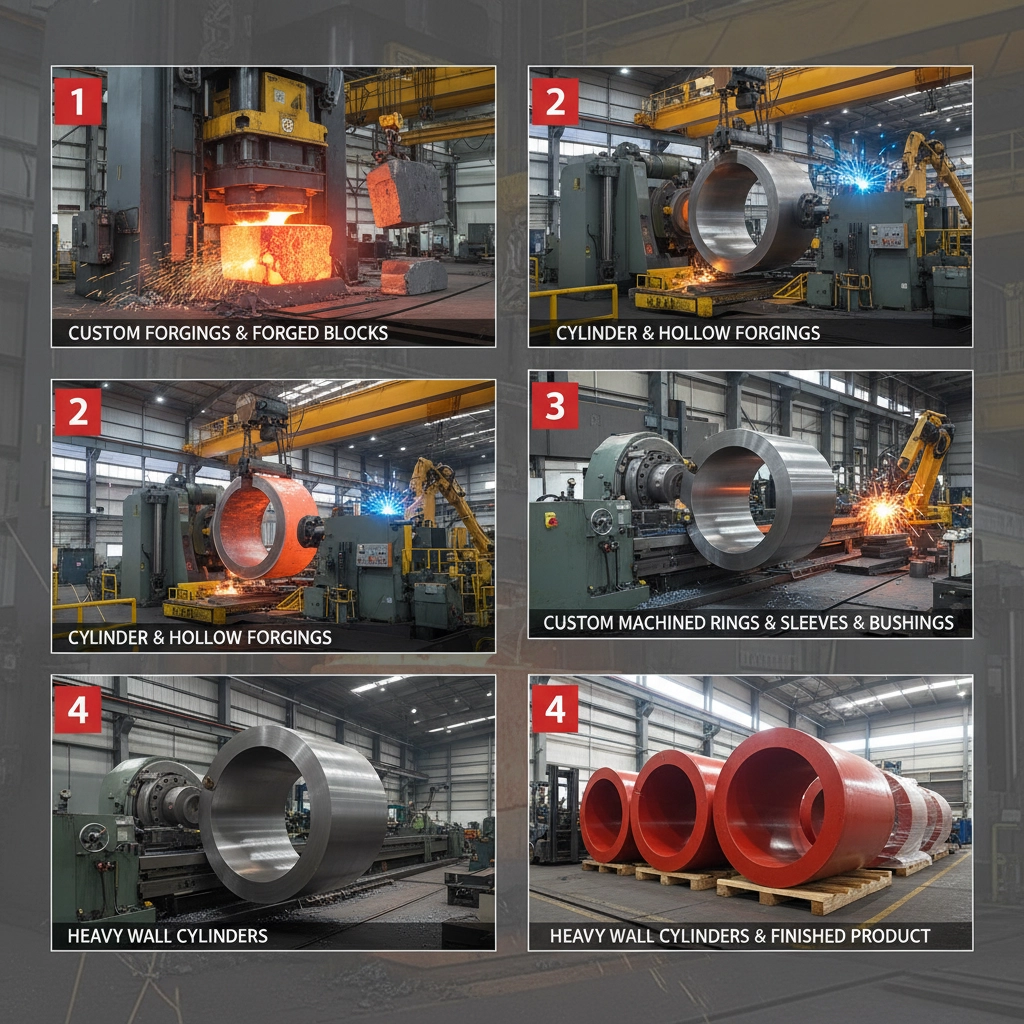
In the demanding landscape of heavy industrial piping and pressure equipment, the integrity of connection interfaces is paramount. A specialized forged transition section factory provides the critical engineered components necessary to bridge different pipe diameters or material specifications while maintaining structural homogeneity. These components are essential for ensuring that high-pressure systems can withstand extreme operational stresses without the risk of failure associated with welded fabrications.
The global shift toward higher efficiency in energy and chemical processing has increased the demand for precision-forged tubular connections. Unlike rolled or fabricated parts, forged sections offer a dense grain structure that is superior in resisting fatigue and corrosion. For procurement managers and engineers, selecting a partner capable of delivering strict wall-thickness reliability and precise transition geometry is the primary driver for operational safety.
When searching for a reliable forged transition section factory, industry professionals prioritize the ability to control deformation during heat treatment and rough machining. By utilizing forged preforms instead of fabricated alternatives, designers can significantly enhance the load-bearing capacity of heavy piping systems and special equipment connections.

Global Industry Context of Forged Transition Sections
The global demand for high-pressure piping interfaces is driven by the expansion of the petrochemical, nuclear, and aerospace sectors. According to international quality standards such as ISO and EN, the reliability of transition pieces is a critical safety metric. Many traditional systems relied on fabricated transitions, but the industry is shifting toward monolithic forged sections to eliminate weld-seam vulnerabilities in critical process lines.
The challenge lies in managing the complex deformation of metals during the forging process to ensure that wall thicknesses remain consistent. A professional forged transition section factory addresses this by implementing advanced heat treatment and precision rough machining, ensuring that the final product meets the stringent requirements of heavy loading and thermal cycling.
Defining the Role of a Forged Transition Section Factory
A forged transition section factory is a specialized manufacturing facility that transforms raw alloy steel into high-strength tubular connections. These factories focus on creating preforms that serve as the structural heart of pressure equipment, providing a seamless transition between different diameters or geometries. This process is fundamental to modern industrial infrastructure where safety cannot be compromised.
In simpler terms, these factories provide a "stronger version" of a pipe connector. Instead of welding plates together to make a cone or a reducer, the material is hammered and pressed into shape. This ensures the grain of the metal flows with the contour of the part, which significantly increases its resistance to internal pressure and external vibration.
This capability is vital for humanitarian and infrastructure projects, such as the construction of desalination plants in remote regions or the upgrading of aging energy grids. By providing a single, robust forged piece, the factory reduces the need for extensive on-site welding, thereby accelerating project timelines and reducing the probability of field leaks.
Core Components of High-Performance Forgings
The performance of a product from a forged transition section factory depends on several technical pillars. First is structural integrity; precision forging ensures a dense grain structure, which reduces structural risks during heavy loading. This is achieved through rigorous control of the forging temperature and the pressure applied by advanced forging presses.
Material selection is the second core component. A reputable forged transition section factory utilizes premium carbon steel, low-alloy steel, Cr-Mo steel, and stainless steel. The use of CrMo or CrNiMo alloys is particularly critical for components operating in high-temperature environments, where thermal stability and creep resistance are non-negotiable.
Finally, dimensional precision and traceability complete the quality loop. Every part must have strict center-line alignment to ensure vibration-free rotation in high-speed applications. Full traceability, supported by EN 10204 3.1 certifications and UT reports, ensures that every single piece of metal can be traced back to its original heat number.
Global Applications and Industrial Use Cases
Forged pipe sections are utilized globally in environments where failure is not an option. In the oil and gas sector, these components are used in high-pressure manifolds and process lines to connect dissimilar piping sizes. In nuclear power plants, the thermal stability of forged transitions prevents warping during the extreme heat cycles typical of reactor cooling systems.
Beyond traditional energy, these products are essential in heavy machinery and aerospace interfaces. For example, in large-scale turbine housing or heavy-wall cylinder connections, a forged preform is preferred over a rolled part to ensure maximum torsional strength and a reduction in centrifugal force due to the hollow architecture.
Performance Metrics by Forged Transition Section Factory Method
Tangible Advantages and Long-Term Value
The primary advantage of sourcing from a dedicated forged transition section factory is the dramatic increase in reliability. By utilizing a dense grain structure, these components significantly reduce the risk of stress corrosion cracking and fatigue failure. This leads to lower maintenance costs over the lifespan of the equipment and minimizes unplanned downtime in critical production lines.
From a logical and economic perspective, the "optimized weight" of hollow forged architectures reduces overall mass without compromising strength. This efficiency translates to lower shipping costs and easier installation. Emotionally, the provision of full traceability and third-party witness inspections provides engineers with the peace of mind that their designs are supported by the highest quality materials.
Future Trends in Forging Innovation
The future of the forged transition section factory is being shaped by the digital transformation of metallurgy. The integration of real-time tracking for heat treatment cycles is now becoming standard, preventing material degradation and ensuring that each part adheres exactly to the project-specific dossier.
Sustainability is also driving innovation. There is a growing movement toward "green forging," where energy-efficient presses and recycled high-alloy steels are used to reduce the carbon footprint of heavy industrial components. This aligns with global ESG goals while maintaining the structural integrity required for high-pressure environments.
Furthermore, automation in rough machining is reducing the time between forging and delivery. By incorporating advanced CNC facing and boring before shipment, factories can deliver semi-finished parts that require minimal final machining by the customer, effectively streamlining the entire global supply chain.
Overcoming Technical Challenges in Production
One of the most significant challenges for any forged transition section factory is controlling deformation during the cooling phase. To combat this, advanced straightening and controlled heat treatment are employed to prevent warping, ensuring that the component remains concentric and true to its design geometry.
Another hurdle is the detection of internal defects in very thick-walled sections. The solution is the implementation of 100% ultrasonic volume testing (UT), coupled with Magnetic Particle (MT) or Penetrant Testing (PT). These NDT methods ensure that any internal porosity or inclusions are identified long before the part reaches the installation site.
Finally, managing the logistics of massive components—some weighing up to 60 tons—requires specialized heavy-load packaging. To prevent transport deformation, factories utilize custom-engineered skids and bracing, ensuring that the precision-machined faces arrive in perfect condition.
Comparison of Forging Production Standards for Transition Sections
| Control Dimension |
Standard Forging |
Precision Forging |
Project-Specific Grade |
| Grain Structure |
Coarse |
Refined |
Ultra-Dense |
| Wall Uniformity |
Moderate |
High |
Strictly Controlled |
| NDT Coverage |
Random Sampling |
100% UT |
UT + MT + PMI |
| Certifications |
Mill Certificate |
EN 10204 3.1 |
3.1 + Third Party Witness |
| Tolerances |
Standard |
Tight |
Custom/Precision |
| Delivery State |
As Forged |
Rough Machined |
Finish Machined |
FAQS
Forged sections provide a continuous grain flow that follows the part's geometry, significantly increasing structural integrity and fatigue resistance. Fabricated parts rely on welds, which are potential points of failure under high pressure or extreme temperature cycling. A professional forged transition section factory ensures the wall thickness is uniform and the material is dense, making it safer for heavy piping interfaces.
Depending on the application, materials include carbon steel, low-alloy steel, and stainless steel. For high-temperature or corrosive environments, Cr-Mo or CrNiMo steels are preferred. The choice depends on the operating pressure, temperature, and the chemical nature of the fluid being transported, all of which are managed during the material sourcing phase at the factory.
Comprehensive inspection options include 100% Ultrasonic Testing (UT) for internal volume defects, Magnetic Particle (MT) or Penetrant Testing (PT) for surface flaws, Positive Material Identification (PMI) to verify alloy composition, hardness checks, and mechanical testing. Many factories also coordinate third-party witness arrangements to meet strict project specifications.
Yes, products can be supplied in various conditions: as forged, heat-treated, rough-machined, semi-finished, or fully finish-machined. By performing precision rough machining of journals and faces at the factory, customers can significantly reduce their own machining time and costs upon delivery.
Traceability is guaranteed through the provision of EN 10204 3.1 certifications, which link the finished part back to the original melt of the steel. This documentation is accompanied by heat-treatment records, dimensional reports, and NDT reports, creating a complete project-specific dossier for every component.
For heavy-load shafts and sections, often weighing up to 60 tons, specialized packaging is used. This includes reinforced heavy-duty skids, custom bracing to prevent shifting, and protective coatings on machined faces to prevent corrosion and physical damage during international transit.
Conclusion
The role of a specialized forged transition section factory is indispensable in the construction of safe, efficient, and durable heavy industrial piping systems. By prioritizing structural integrity through precision forging, rigorous NDT testing, and absolute material traceability, these factories provide the critical components that prevent system failures in the world's most demanding environments. From the selection of premium Cr-Mo alloys to the precision of rough machining, every step is designed to maximize the reliability of the final interface.
As the industry moves toward smarter, greener manufacturing, the integration of digital tracking and sustainable metallurgy will further enhance the value of forged components. For engineers and procurement specialists, investing in high-quality forged transitions is not just a technical decision but a long-term commitment to operational safety and cost-efficiency. To ensure your project meets the highest global standards, visit our website: www.yxs-forging.com.