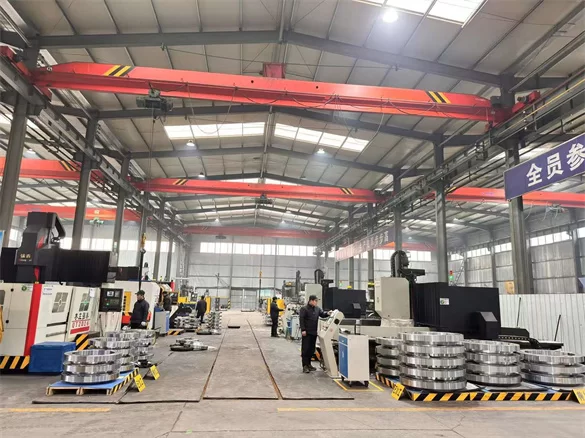
The global demand for high-performance industrial rotating components has placed a significant spotlight on the capabilities of a specialized carbon steel ring forging factory. These facilities are essential for producing the critical structural elements that power heavy machinery, turbines, and transmission systems, where material integrity is non-negotiable. By transforming raw alloy steel into precision-engineered rings and shafts, these factories ensure that industrial infrastructure can withstand extreme torsional stress and centrifugal forces.
In the modern manufacturing landscape, the shift toward "near-net shape" production has redefined the role of the forging plant. A professional carbon steel ring forging factory no longer simply provides a raw blank; it delivers semi-finished components with strict concentricity and straightness controls. This evolution reduces material waste and significantly shortens the machining cycle for the end-user, providing a strategic advantage in an era of tightening supply chains and rising material costs.
Whether it is for power generation, paper mills, or heavy-duty motor shafts, the reliability of the final product depends on the grain flow and thermal stability achieved during the forging process. Partnering with an experienced carbon steel ring forging factory ensures that components like hollow main shafts possess the structural density required to prevent fatigue failure under high-load operating conditions.

The Strategic Role of a Carbon Steel Ring Forging Factory
A carbon steel ring forging factory serves as the backbone of heavy industrial engineering by providing the essential building blocks for rotating machinery. By utilizing high-pressure forging presses, these factories refine the internal grain structure of the steel, which is critical for components like turbine shafts and large fan shafts. This process eliminates internal voids and porosities that are common in casting, thereby drastically increasing the fatigue life of the part.
The strategic importance lies in the ability to handle massive scales—such as unit weights up to 60 tons—while maintaining strict dimensional tolerances. This capability allows engineers to design larger, more powerful systems without fearing the structural risks associated with material inconsistency. The integration of advanced heat treatment ensures that the resulting rings and shafts remain stable during the subsequent precision machining phases.
Defining Precision in Forged Ring Production
In simple terms, a carbon steel ring forging factory is a specialized manufacturing facility that uses heat and compressive force to shape steel into ring or shaft forms. Unlike machining a part from a solid block, forging aligns the metal's grain flow to follow the contour of the part, which significantly enhances its strength. For hollow main shaft forgings, this means the component can be lighter yet stronger, providing internal passages for lubrication.
The connection to modern industry is rooted in the need for "Main-shaft grade" precision. This involves not just the outer diameter, but a rigorous control of concentricity and straightness. When a shaft reaches lengths of 8000mm, even a minor deviation can cause catastrophic vibration at high speeds. Therefore, the "precision" in a forging factory refers to the ability to manage thermal straightening and L/D ratio stability.
Ultimately, this level of manufacturing supports humanitarian and global infrastructure needs by ensuring the reliability of power plants, water treatment facilities, and transport systems. By reducing the risk of sudden structural failure in critical transmission members, these factories contribute to the overall safety and efficiency of the global industrial grid.
Core Technical Components of Forged Hollow Shafts
The structural integrity of a component produced by a carbon steel ring forging factory depends heavily on material selection. Utilizing premium alloy steels such as 42CrMo4 or 17CrNiMo6 allows for superior hardenability and toughness. These materials are chosen specifically to resist the heavy loading and high-torque environments found in turbine and motor shafts.
A key technical focus within the carbon steel ring forging factory is the management of the hollow architecture. By optimizing the internal bore, the factory reduces centrifugal force and total mass without compromising the torsional strength. This is essential for high-speed rotating systems where reducing the moment of inertia leads to better energy efficiency and lower wear on bearings.
Furthermore, the supply condition—typically Quenched and Tempered—ensures that the material possesses the required mechanical properties before it even reaches the machining stage. By providing rough machining on ID, OD, and journals, the factory reduces the customer's processing time while ensuring there is sufficient dimensional allowance for final precision grinding.
Performance Metrics for High-Stress Forgings
When evaluating the output of a carbon steel ring forging factory, engineers look at specific performance metrics that differentiate precision forgings from standard cast parts. The primary metric is the structural fatigue life, which is exponentially higher in forged components due to the dense grain flow. Additionally, the rotational stability is measured by the center-line alignment, ensuring vibration-free operation.
Another critical factor is the material waste ratio. Near-net shape forging allows the factory to produce blanks that are very close to the final geometry, reducing the amount of expensive alloy steel that is turned into chips during machining. This not only lowers the cost but also minimizes the environmental footprint of the production process.
Comparative Performance Ratings of Forging Methods
Global Applications of Precision Forged Rings
The applications of components from a carbon steel ring forging factory span across the most demanding industrial sectors. In the power generation sector, turbine shafts rely on the high-concentricity and thermal stability of these forgings to operate for decades without failure. Similarly, in the pulp and paper industry, large paper mill rolls require the extreme torsional strength that only precision forging can provide.
Beyond traditional factories, these components are critical in remote industrial zones and heavy-duty transportation infrastructure. For example, the large fan shafts used in industrial cooling towers must withstand constant cyclic loading. By utilizing 34CrNiMo6 alloy steel, these forged components ensure that the machinery maintains operational dignity and safety, even in the harshest environmental conditions.
Long-Term Value and Structural Integrity
The long-term value of investing in a premium carbon steel ring forging factory extends far beyond the initial purchase price. The primary driver is the reduction in maintenance costs; because forged shafts have superior rotational stability, the intervals between balancing and alignment checks are significantly extended. This minimizes downtime in critical production lines.
From a safety perspective, the 100% Ultrasonic Testing (UT) and EN 10204 3.1 certification provide an insurance policy against internal defects. In high-pressure systems, a single internal void can lead to a catastrophic rupture. The dense grain structure ensured by professional forging virtually eliminates this risk, providing peace of mind to plant managers.
Furthermore, the ability to customize geometry—specifically the allowance for journals and tapers—means that the components are tailored to the customer's specific machining sequence. This bespoke approach ensures that the final product achieves the perfect geometry without inducing residual stresses during the final grinding process.
Future Trends in Carbon Steel Forging Technology
As the industry moves toward Industry 4.0, the carbon steel ring forging factory is integrating digital transformation into its quality monitoring. Real-time tracking of heat treatment cycles is becoming standard, allowing for precise control over the quenching process to prevent material degradation. This ensures that every shaft, regardless of size, has uniform mechanical properties.
Sustainability is also driving innovation, with a focus on "Green Forging." This includes the adoption of more energy-efficient induction heating and the reduction of material waste through advanced simulation software. By predicting the metal flow during the forging process, factories can optimize the starting billet size, reducing the carbon footprint associated with raw material production.
Moreover, the development of new high-performance alloy steels is expanding the limits of what can be forged. The combination of automation in rough machining and more stringent NDT (Non-Destructive Testing) standards is allowing for the production of even larger hollow shafts, supporting the next generation of ultra-large-scale power turbines and industrial motors.
Technical Comparison of Forging Quality and Material Performance
| Material Grade |
Torsional Strength |
Fatigue Resistance |
Application Fit |
| 42CrMo4 |
High |
Moderate |
General Motor Shafts |
| 34CrNiMo6 |
Exceptional |
High |
Turbine Main Shafts |
| 17CrNiMo6 |
Maximum |
Exceptional |
Heavy-duty Gear Rings |
| Carbon Steel (Std) |
Moderate |
Low |
Light Duty Rollers |
| Alloy Steel (Custom) |
Variable |
Variable |
Specialized Machinery |
| Ni-Cr-Mo Alloy |
Exceptional |
High |
High-Torque Spindles |
FAQS
Hollow shaft forgings significantly reduce the total mass and centrifugal forces in rotating systems. This improvement in energy efficiency allows for the integration of internal lubrication or cabling without compromising the required torsional strength, which is essential for large-scale industrial equipment.
A professional carbon steel ring forging factory employs a combination of controlled cooling, precision thermal straightening, and rigorous measurement reporting. This multi-step process ensures that the forged blank meets strict straightness tolerances required for main spindles before delivery.
For high-torque applications, 34CrNiMo6 and 17CrNiMo6 are highly recommended. These alloy steels provide excellent hardenability, toughness, and fatigue resistance, ensuring the shaft can handle extreme operating loads without structural failure.
Every shipment is accompanied by a comprehensive data package, including EN 10204 3.1 certificates, 100% ultrasonic testing (UT) reports, and detailed mechanical property verification documents to ensure full traceability and safety.
Yes, we provide rough machining on the ID, OD, faces, and journals. This ensures the customer receives a workpiece with sufficient stock for final precision grinding while significantly reducing the total machining time and cost on the client's end.
Our facility is equipped to handle hollow main shaft forgings with unit weights up to 60 tons. This capability allows us to support large-scale industrial equipment, including power generation turbines and massive industrial rolls.
Conclusion
In summary, the role of a high-precision carbon steel ring forging factory is indispensable for the creation of heavy-duty rotating systems. By focusing on superior concentricity, stringent straightness control, and the use of high-grade alloy steels, these facilities provide the structural integrity and rotational stability required for the world's most demanding industrial applications. From reducing material waste to enhancing fatigue life through optimized grain flow, the value of precision forging is evident in every single component.
Looking forward, the integration of digital monitoring and green forging techniques will further elevate the standards of the industry. For companies seeking to optimize their equipment's lifespan and operational efficiency, partnering with a factory that prioritizes full traceability and UT testing is the only way to ensure long-term reliability. We invite you to explore our precision forging solutions to secure the future of your industrial projects. Visit our website: www.yxs-forging.com