- Tel: +86 133 3836 0365
- Email: john@yxs-forging.com

When project specifications demand circular components that exceed the capabilities of standard catalog dimensions, the reliance shifts toward specialized forging expertise. The challenge often lies in bridging the gap between a raw material's theoretical strength and the precision required for a seamless assembly in high-stress industrial environments.
For critical infrastructure and heavy machinery, the structural integrity of a ring component determines the longevity of the entire system. This is where the strategic selection of a carbon steel ring forging factory becomes essential, as the process must ensure a dense grain flow that eliminates the internal porosity common in casting.
This analysis explores the technical requirements of custom forged rings, from material selection to precision CNC finishing, providing a framework for engineers to evaluate the viability of forged versus cast solutions for non-standard industrial equipment.


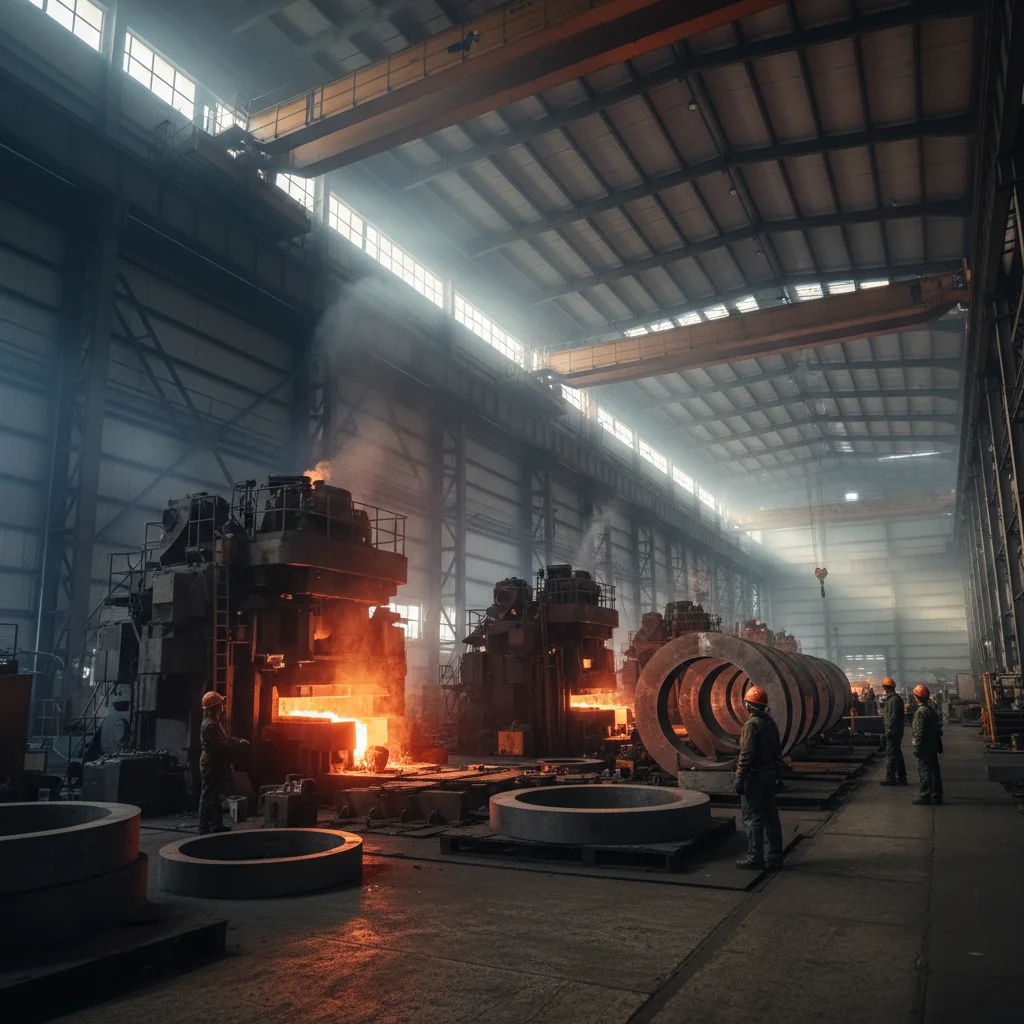
Unlike casting, which involves melting metal and pouring it into a mold, forging utilizes mechanical pressure to reshape the metal in a solid state. This process aligns the grain structure of the carbon steel to follow the contour of the ring, which significantly enhances the component's resistance to fatigue and impact.
For a carbon steel ring forging factory, the goal is to optimize this grain flow to eliminate internal voids. The resulting dense structure allows these rings to withstand higher cyclic loads, making them the only viable choice for project-critical applications where a failure could lead to catastrophic equipment downtime.
Custom rings are engineered based on technical drawings rather than standard catalogs. The design logic begins with the identification of the stress profile of the part. If the component is subject to high radial or axial loads, the forging process is tailored to ensure the material properties are consistent across the entire cross-section.
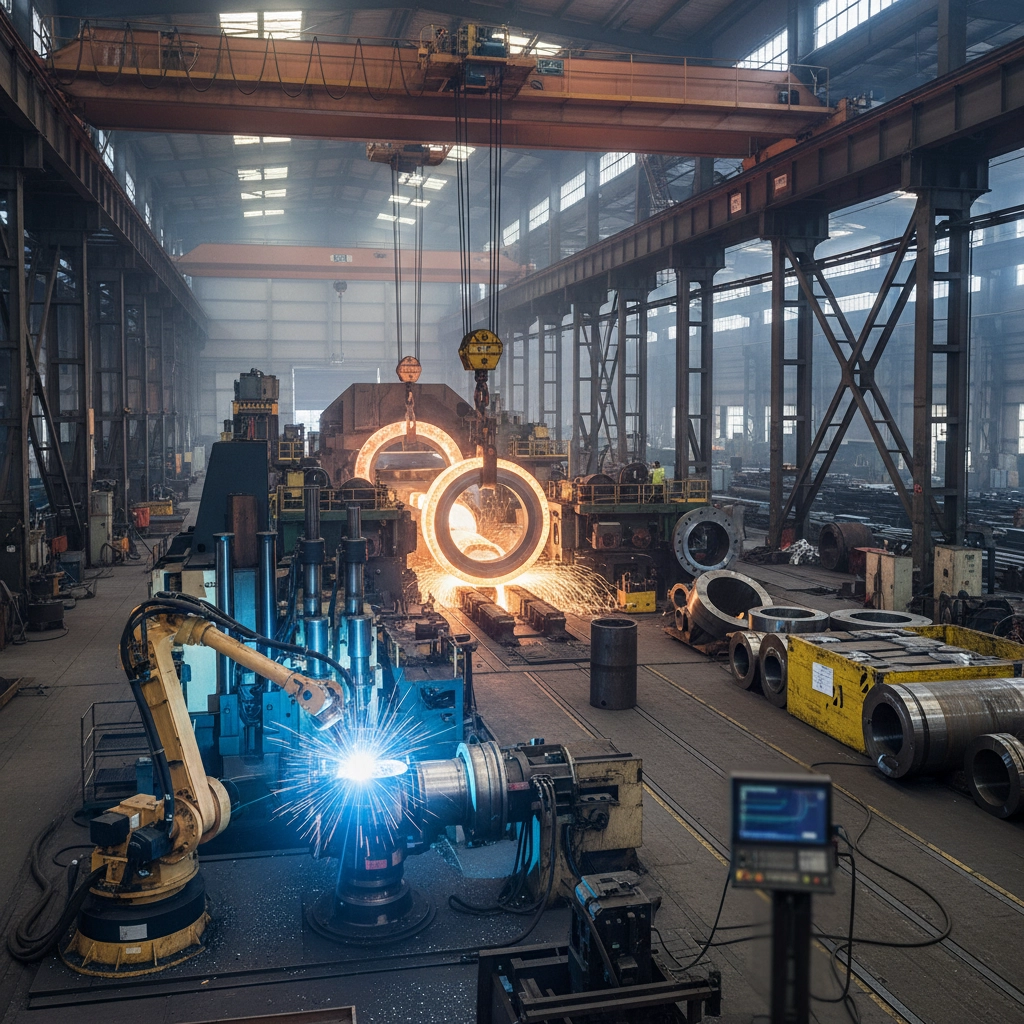
Integration of precision machining is the second critical phase. To reduce lead times for the end-user, these rings are often delivered as rough-machined or semi-finished parts. This allows for the creation of specialized features—such as stepped profiles, internal grooves, and precision-drilled holes—that are essential for complex assembly profiles.
The transition from a forged blank to a finished component requires a rigorous control of tolerances. By utilizing CNC turning, the gap between raw forged reliability and precision engineering is closed, ensuring that non-standard industrial equipment receives a part that fits exactly as designed in the engineering blueprint.
The choice of material—whether Carbon, Alloy, Stainless, or Duplex Steel—is dictated by the operating environment. Carbon steel remains the industry standard for heavy structural rings due to its balance of strength and cost-effectiveness, but specialized applications may require the corrosion resistance of Duplex alloys.
The mechanical properties of a forged ring are not solely a product of the material, but a result of the synergy between forging pressure and customized heat treatment cycles used to achieve precise hardness and tensile strength.
Thermal treatment is used to relieve internal stresses induced during the forging process. By controlling the cooling rates and tempering temperatures, the material's microstructure is refined, preventing brittle fractures under high-stress conditions and ensuring long-term durability in heavy industrial applications.
Scaling is a primary differentiator among forging facilities. The ability to produce rings with an Outer Diameter (OD) of up to 8000mm and unit weights reaching 30 tons requires massive press capacities and specialized handling equipment. Such capabilities are essential for the energy, marine, and heavy mining sectors.
Beyond raw size, the ability to maintain concentricity and wall thickness across massive diameters is the true measure of technical proficiency. The following index illustrates the relative importance of various technical capabilities when sourcing from a heavy forging facility.
In a typical industrial setting, such as the construction of a high-pressure vessel or a heavy-duty turbine housing, standard catalog rings often fail to meet the required seal surfaces or load-bearing profiles. When an engineer specifies a custom ring, they are typically solving for a specific mechanical failure point or adapting a design for a non-standard assembly.
These components are frequently used as transition pieces, nozzle necks, or custom flanges. By providing the ring in a semi-finished state with pre-machined functional surfaces, the manufacturer streamlines the downstream assembly process, reducing the risk of machining errors at the final integration site.
The integrity of a forged ring is verified through a multi-stage Non-Destructive Testing (NDT) protocol. Because internal defects in heavy forgings can be invisible to the naked eye, Ultrasonic Testing (UT) is employed to scan the volume of the material for inclusions or voids.
Complementary methods include Magnetic Particle Testing (MT) and Penetrant Testing (PT) to identify surface-level cracks. For materials where composition is critical, Positive Material Identification (PMI) ensures that the alloy meets the exact grade specified in the project's Inspection Test Plan (ITP).
Documentation is the final pillar of quality. Full traceability is provided via EN 10204 3.1 or 3.2 certification, accompanying dimensional reports that prove the component adheres to the engineering drawings. This level of verification is mandatory for safety-critical industrial applications.
Deciding between a forged ring and a cast ring depends on the expected load and the risk tolerance of the project. While casting is often more economical for extremely complex geometries that do not face high stress, it introduces the risk of porosity and uneven grain structure.
Forged rings offer a superior density that translates directly into a longer service life, particularly in high-vibration or high-pressure environments. The trade-off is typically a higher initial investment, but this is offset by reduced failure rates and lower maintenance costs over the equipment's lifecycle.
The following comparison framework outlines the key decision factors for engineers evaluating these two manufacturing routes.
| Evaluation Factor | Custom Forged Rings | Standard Cast Rings | Project Impact |
|---|---|---|---|
| Structural Strength | Superior (Dense Grain) | Moderate (Potential Porosity) | Failure Risk |
| Customization | Unlimited Drawing-based | Limited to Mold Design | Design Flexibility |
| Dimensional Precision | High (CNC Finished) | Rough Tolerances | Assembly Fit |
| Service Life | Extended / High Stress | Standard / Low Stress | OPEX Costs |
| Risk Management | Verified via NDT/Traceability | Higher Failure Probability | Safety Compliance |
| Lead Time (Finish) | Reduced via Pre-machining | High Post-cast Machining | Project Timeline |
Large-scale forging facilities can produce custom rings with an Outer Diameter (OD) of up to 8000mm. These components can reach unit weights of up to 30 tons, provided the facility possesses the necessary press capacity and heat treatment ovens to manage such massive volumes of steel while maintaining structural uniformity.
Yes. By combining the forging process with CNC machining, rings can be delivered with precise features including specialized grooves, stepped profiles, and holes. These can be supplied as rough-machined or semi-finished components, ensuring they align perfectly with the technical drawings for non-standard industrial equipment.
The choice depends on the environment: Carbon steel is ideal for general structural strength; Alloy steel is used for higher hardness and tensile requirements; Stainless and Duplex steels are selected for applications involving corrosive agents or extreme chemical exposure. Each material is then subjected to specific heat treatment to optimize its performance.
Industry-standard documentation includes EN 10204 3.1 or 3.2 certificates, which provide full material traceability from the heat number of the raw ingot to the final part. Additionally, dimensional reports and NDT results (UT, MT, PT) are required to verify that the part is defect-free and meets all technical specifications.
Forging significantly reduces the risk of internal porosity and casting defects. Because the metal is worked in a solid state, the grain flow is optimized for strength. When combined with rigorous NDT (Ultrasonic Testing), the probability of unexpected material failure in high-stress environments is drastically lowered compared to cast alternatives.
Depending on the client's manufacturing route, rings can be supplied in several stages: as-forged blanks, heat-treated rings, rough-machined, or semi-finished components. Semi-finished parts are often preferred as they reduce the amount of material removal and machining time required at the final assembly site.
Selecting a custom forged ring is an exercise in risk mitigation and precision engineering. For components where standard dimensions are insufficient and structural failure is not an option, the transition to a specialized forging process is the only way to ensure long-term reliability and safety.
By focusing on grain flow optimization, rigorous NDT validation, and precision CNC finishing, manufacturers can provide components that bridge the gap between raw material strength and complex industrial geometry, ensuring a perfect fit for the world's most demanding equipment.